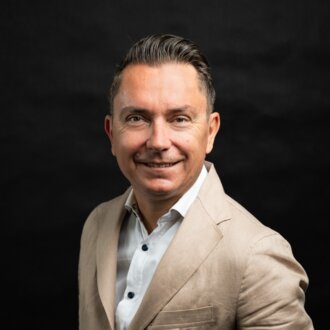
The Year 2025 Through the Eyes of the Chairman of the Management Board
The year 2025 was a financial success. We managed to increase copyright revenue in virtually all areas. We would like to thank our ever-growing community of composers, lyricists, and music publishers for their trust. Last year, our community grew by a record 694 music authors and 10 music publishers who signed contracts with us, joining a community of nearly 13,000 domestic authors and publishers and more than five million authors and publishers from around the world whom we have the honor of representing.
Authors who have recently switched to us from foreign partners particularly appreciate the quality of our services, the speed of payments, and their regularity. We pay royalties from radio and television broadcasts, digital services, and concerts every month—a service that only three organizations in the world can boast of.
I believe that the long-term strengthening of our corporate culture is bearing fruit; we build this culture on the foundations of a free environment, the high quality of the services we provide, and the principles of trust, placing our employees and authors at the very heart of the organization.
I would like to thank all OSA employees who, in 2025, managed to negotiate rights for music authors and publishers totaling 1.662 billion CZK. This represents a year-over-year increase of 128 million CZK. From the royalties collected, we were able to distribute and pay out 1.17 billion CZK last year to 219,000 composers, lyricists, and music publishers from around the world. An additional 250 million CZK from last year’s collections will be paid out in the first half of this year. In terms of costs, the average overhead ratio (the ratio of costs to total collections) reached 11.98%, which has long ranked OSA among the best-managed music rights organizations in the world.
Revenues from digital services have shown the strongest growth over the past two years. Last year alone, we managed to increase revenue by CZK 66 million and surpass the CZK 300 million mark in this segment. It turns out that our decision to invest in internal development so that we could process high volumes of data from all multinational platforms every month was visionary. We did this even before the pandemic, when the popularity of these services was not yet high. In the Central and Eastern European region, we are thus the only ones today capable of using our own technology to process monthly reports on the music played by our authors for subscribers of digital platforms across the entire EU.
Digital platforms and social media have significantly expanded the scope of opportunities for music creators and artists. However, they have fundamentally transformed the business model. Society has learned to consume creative content quickly… perhaps too quickly, which can lead to a sense that the work no longer holds the same quality. There is no time for longer passages; every click counts, and you must capture the attention of young listeners within three seconds. The problem with quality, however, does not lie in a lack of talent among young artists, but in the business model itself. And artificial intelligence is making a significant entry into this environment.
Across artistic professions, the debate over artificial intelligence intensified last year. Some artists are beginning to feel its impact on their earnings. A legal framework and a functional business model are still lacking—a model that would finally and systematically reward creators and artists for training algorithms on their work and performances. However, we must also take into account the years spent building a career, pursuing education, investing in the development of one’s talent, marketing, and so on. That is why I am not speaking of a one-time settlement for damages caused, but of a long-term, sustainable business relationship between artificial intelligence service providers and the creators and artists themselves. Only in this way can we create a just coexistence between our culture, based on human creativity, and artificial intelligence tools. Otherwise, we will allow the market to be cannibalized by algorithm-generated content. In other words, we will allow a paradoxical situation where the talent and success of the creators of original works, used to train algorithms, will compete with and take away the livelihoods of the creators themselves. As a society, we must not allow the ownership of creative works to be redefined, ending up in the hands of digital giants, and causing the essential connection between the original author and their work to fade away.
Our predecessors founded OSA in 1919 with the ambition to create an economically stable environment and help build the music market. An environment where composers and lyricists can create freely, and OSA ensures they receive fair compensation from those who listen to music and use it for their businesses. And this mission remains unchanged even today.
On behalf of the OSA Management Board
Roman Strejček